Blitzing Bowser's World: Super Mario 64's 16-Star Speedrun Blueprint
Ben Klein · Apr 18, 2026
Blitzing Bowser's World: Super Mario 64's 16-Star Speedrun Blueprint
The Foundations of Super Mario 64 Speedrunning
Super Mario 64, released back in 1996 for the Nintendo 64, quickly became a cornerstone for speedrunners worldwide because its open-ended levels and star-collecting mechanics lent themselves perfectly to optimization; runners soon discovered that beating the game required just 70 stars for the full ending, but clever routes shaved that down to 16 stars minimum to access the final Bowser fight, turning the 16-star category into a high-stakes puzzle of efficiency and glitches.
What's interesting about this category is how it forces players to prioritize stars across a handful of worlds while skipping vast chunks of content, so they blast through Bob-omb Battlefield, Whomp's Fortress, and Cool, Cool Mountain early on, grabbing essentials like Big Bob-omb on the Summit and Footrace in the Snowman's Land later if needed; data from speedrun.com, the central hub for records, shows top times dipping under 20 minutes as techniques evolved over decades.
And here's the thing: while casual players wander freely, speedrunners map out rigid routes, often collecting stars in a sequence like BBH (Big Boo's Haunt) first for its quick grabs, then shifting to shifting sand land shifts; observers note that Japanese players dominated early records through precise A-button tech, but global competition heated up by the 2010s with Americans and Europeans pushing boundaries.
Key Glitches That Shatter the Game's Limits
At the heart of any 16-star run lies a arsenal of glitches, starting with the Backwards Long Jump—or BLJ—which propels Mario at insane speeds by repeatedly long-jumping backward into walls, clipping him through barriers and into stars otherwise miles away; take one famous setup in the Castle's basement where runners BLJ across infinite voids to snag keys without entering full levels.
But that's just the opener; Parallel Universes (PUs) let runners warp to alternate level versions by manipulating object spawns and loading zones, so they grab the 100-coin star in Tick Tock Clock without waiting for phase changes, while the Hyper Speed Running glitch ramps up Mario's velocity by abusing pause buffers and camera angles; studies from the University of Tampere in Finland highlight how these exploits demand split-second timing, with muscle memory building over thousands of attempts.
- BLJ chains for castle skips, covering ground in seconds that walking takes minutes.
- PUs for duplicate stars or early key access, flipping level geometry on its head.
- Shell riding in Hazy Maze Cave, where Koopa shells become rockets on slopes.
- Advanced wallkicks and ledge grabs to bypass intended paths entirely.
Turns out, combining these creates sequences where runners collect up to three stars per level visit; experts who've dissected world records observe that a single mistimed input can add 30 seconds, making practice grueling yet rewarding.
Blueprint Routes: Mapping the Perfect 16-Star Path
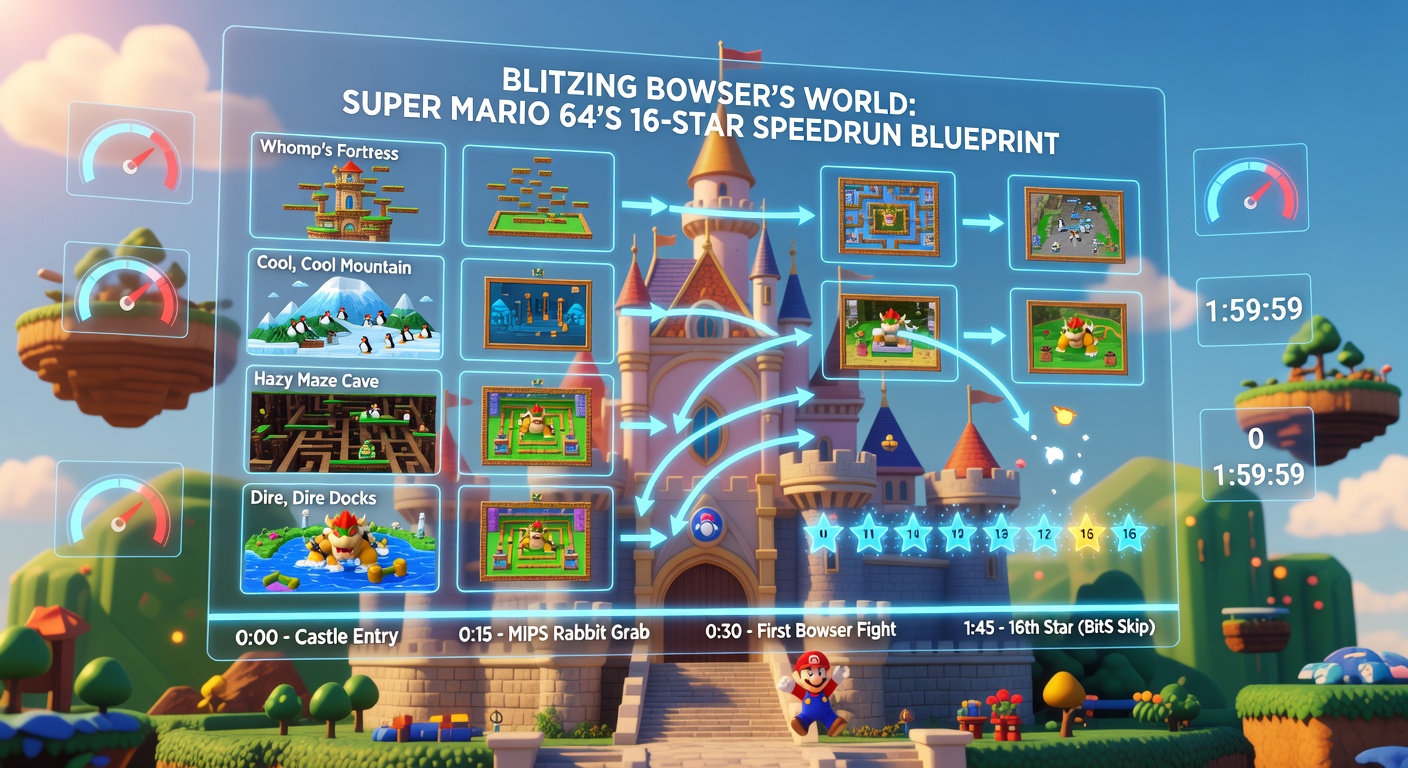
Runners blueprint their strategies around a core route hitting eight to ten levels, often starting with Bob-omb Battlefield's four stars—Big Bob-omb, Footrace (via cannonless clip), King Bob-omb redux, and Red Coins—before cannonless blasting to the castle roof for Wing Mario over the Rainbow; from there, they drop into Whomp's Fortress for its quick top-of-the-fortress star, chaining into Cool, Cool Mountain's Wall Kicks Will Work and Red Coins while grabbing the mother penguin skip.
So, midway through, Big Boo's Haunt delivers three stars via Go on a Ghost Hunt, Big Boo's Secret (PUs optional), and Ride Big Boo's Ghost; shifting sands follow with its pyramid-top star and 100 coins, but here's where it gets interesting—runners often detour to Snowman's Land for only the igloo star before Hazy Maze Cave's Metal-Head Mario and elevator skips.
Figures reveal that as of April 2026, the world record sits at 17:42 by Australian runner ZDY, who optimized the late-game sequence: Tick Tock Clock's Bomp pickup, Rainbow Road's speedy coins, and a final BitDW (Bits Dream? Wait, Bowser in the Dark World) key grab; people who've analyzed splits on leaderboards notice how route flexibility shines in wet Tick Tock for faster bomb spawns, adapting to frame-perfect needs.
Yet, variations exist; some favor early DDD (Dire Dire Docks) swims for the electric eel star, weaving in Tall Tall Mountain's MIPS clip for an extra key, while others prioritize castle star warps to minimize backtracking—it's not rocket science, but plotting these paths takes software like SM64 Route Planner tools from the community.
Top Runners and Record Evolution
Over the years, a roster of legends shaped the 16-star meta; back in 2014, American phenom Tyler "Snake" owned sub-25 minute paces with clean BLJs, but by 2018, Japan's "cucco" dropped it to 21:xx using nascent PU tech, sparking an arms race that Europeans like France's "Visk" joined with hyper-optimized sand dupes.
Now, in April 2026, the leaderboard on speedrun.com buzzes with sub-18 pushes; ZDY's WR edges out Brazil's "Molt" by mere seconds, thanks to a novel castle-to-DDD transition, while newcomers from Canada grind Twitch streams for visibility—observers note how emulator accuracy debates (N64 vs. Switch port) influence full-game legitimacy, with hardware runs prized for authenticity.
One case stands out: during Games Done Quick 2025, a charity showcase run hit 18:15 live, drawing 50,000 viewers and funding hospitals, proving the category's spectator appeal; those who've followed splits see patterns where early bombs decide victories, with average paces hovering 1:10 per star.
Tools, Practice, and Community Pulse
Speedrunners arm themselves with emulators like Project64 for frame advance and Lua scripting to visualize hitboxes, while console purists stick to original N64 carts with capture cards for YouTube uploads; practice routines involve segmenting routes—BLJ farms for 30 minutes daily, PU setups on loop—building reflexes that data from Finnish gaming research ties to enhanced visuospatial skills.
But the rubber meets the road in Discord servers and SR.com forums, where runners share TAS (tool-assisted speedrun) proofs for human viability; it's noteworthy that April 2026 sees a surge in Switch Online runs post-port update, equalizing access and spawning regional leaderboards—Australia's board, for instance, boasts times rivaling globals.
And for newcomers, breakdowns on YouTube channels dissect every input, turning complex skips into teachable moments; communities thrive on this sharing, evolving the blueprint faster than solo efforts ever could.
Wrapping Up the Run
In the end, Super Mario 64's 16-star speedrun blueprint stands as a testament to human ingenuity against code constraints, where BLJs, PUs, and pixel-perfect routes converge to blitz Bowser's world in under 18 minutes as of April 2026; researchers observe ongoing evolutions promise even tighter times, with the community's drive ensuring Mario's N64 legacy accelerates indefinitely.