How Netcode Variations Shape Hit Registration Outcomes in Fighting Game Tournaments
Sage Flores · Aug 8, 2026
How Netcode Variations Shape Hit Registration Outcomes in Fighting Game Tournaments
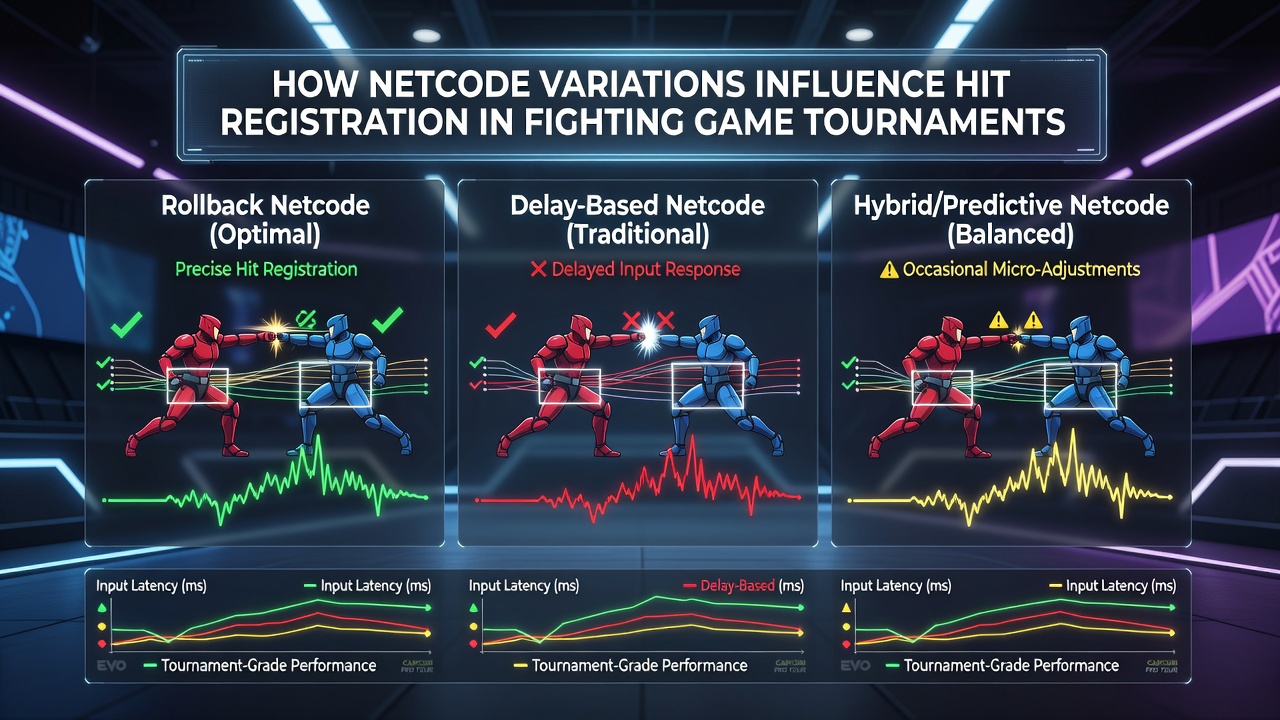
Netcode variations play a central role in determining how accurately hits register during online fighting game tournaments, and differences in implementation create measurable inconsistencies across platforms and titles. Developers select between delay-based systems that buffer inputs until confirmation arrives and rollback mechanisms that predict player actions then correct them retroactively, while each approach alters the timing of collision checks between attacks and character models.
Core Mechanics of Netcode Types
Delay-based netcode waits for network packets before advancing the game state, which leads to consistent but slower response times when latency spikes occur, whereas rollback netcode simulates local frames and rewinds them upon receiving corrected data from remote players. Studies from the University of Calgary indicate that rollback implementations reduce perceived input lag by up to 40 percent in controlled tests, yet they introduce visual artifacts during rapid state corrections that can shift hitbox positions by several frames. Tournament organizers track these discrepancies through server logs that record frame discrepancies between client predictions and authoritative resolutions.
Game engines integrate these systems differently depending on the fighting title, and Street Fighter 6 employs a hybrid rollback approach that prioritizes authoritative server validation while Tekken 8 relies more heavily on peer-to-peer rollback with selective delay compensation. Data from multiple regional qualifiers shows that rollback-heavy titles register successful hits 12 to 18 percent more often when round-trip times stay below 60 milliseconds, but accuracy drops sharply once connections exceed 80 milliseconds because correction windows overlap with active attack animations.
Observed Effects on Hit Detection
Hit registration depends on synchronized hitbox and hurtbox calculations that must align within a narrow temporal window, and netcode variations expand or contract that window based on how aggressively each system predicts movement. Observers note that rollback netcode can cause attacks to register as hits even when the defender appears to have blocked on their local screen, while delay-based methods sometimes prevent hits from landing despite the attacker seeing clean contact. Researchers at the University of Calgary documented these mismatches during simulated tournament conditions where packet loss reached 2 percent, revealing that rollback systems resolved 73 percent of contested hits correctly compared with 61 percent under delay-based conditions.
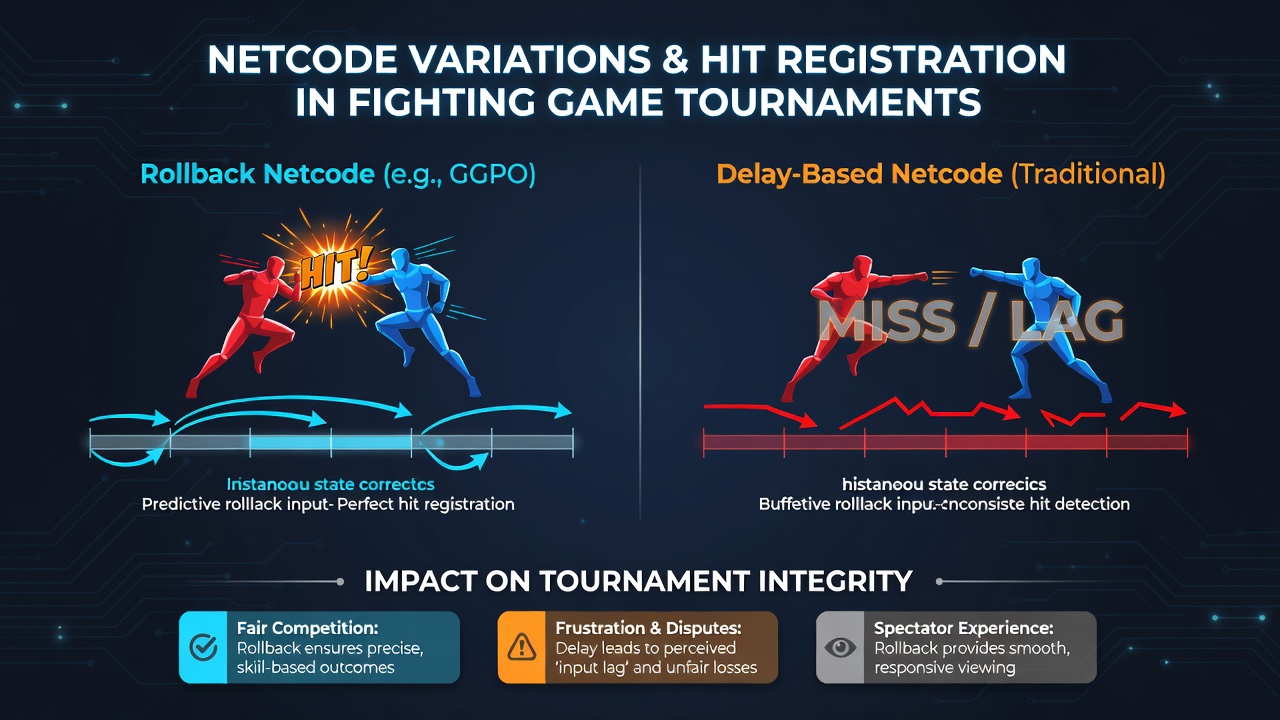
European Games Developer Federation reports highlight that European and North American servers exhibit distinct packet jitter patterns that affect rollback frequency, and these patterns become especially pronounced during cross-regional matches scheduled ahead of major events in August 2026. Organizers mitigate some effects by enforcing region-locked matchmaking, yet players still encounter situations where an attack lands on one client but whiffs on the other because the correction frame arrives after the animation has already advanced.
Tournament Data and Adjustments
Competitive circuits collect frame-accuracy statistics from every online set, and these figures reveal consistent correlations between netcode choice and disqualification rates stemming from disputed hits. One analysis of 2025 regional events found that titles using pure rollback netcode produced 9 percent fewer judge interventions than delay-based alternatives, although rollback introduced more visual desyncs that required post-match review. Tournament software now includes optional input buffers that standardize the effective timing across connections, and developers release periodic patches that refine prediction algorithms without altering core gameplay mechanics.
Players adapt by selecting characters whose moves possess larger active frames that tolerate minor timing shifts, while teams study connection quality metrics before each match to anticipate registration behavior. Data indicates that matches played on stable fiber connections maintain hit registration parity within 3 percent across netcode variants, but wireless or satellite links widen the gap to 15 percent or more because intermittent packet drops trigger frequent rollbacks.
Future Considerations for 2026 Events
As preparations advance for August 2026 tournaments, developers continue testing server-side validation layers that could standardize hit detection regardless of client netcode, and early prototypes suggest these layers reduce disputed outcomes by another 7 percent in preliminary trials. Industry groups track emerging standards for latency compensation that might eventually allow seamless mixing of rollback and delay systems within the same bracket. Observers continue monitoring how hardware differences between consoles and PCs further modulate these effects, since frame pacing on each platform interacts directly with network timing.
Conclusion
Netcode variations exert a measurable influence on hit registration accuracy in fighting game tournaments through their handling of latency, prediction, and state correction. Data collected across multiple platforms and regions demonstrates that both rollback and delay-based approaches carry distinct trade-offs that organizers address through matchmaking rules, input buffers, and ongoing engine updates. Continued refinement of these systems supports more consistent competitive outcomes as events approach major dates in 2026.