Perk Synergy Breakdowns: Maximizing Team Efficiency in Survival Modes
Lars Sullivan · Jun 9, 2026
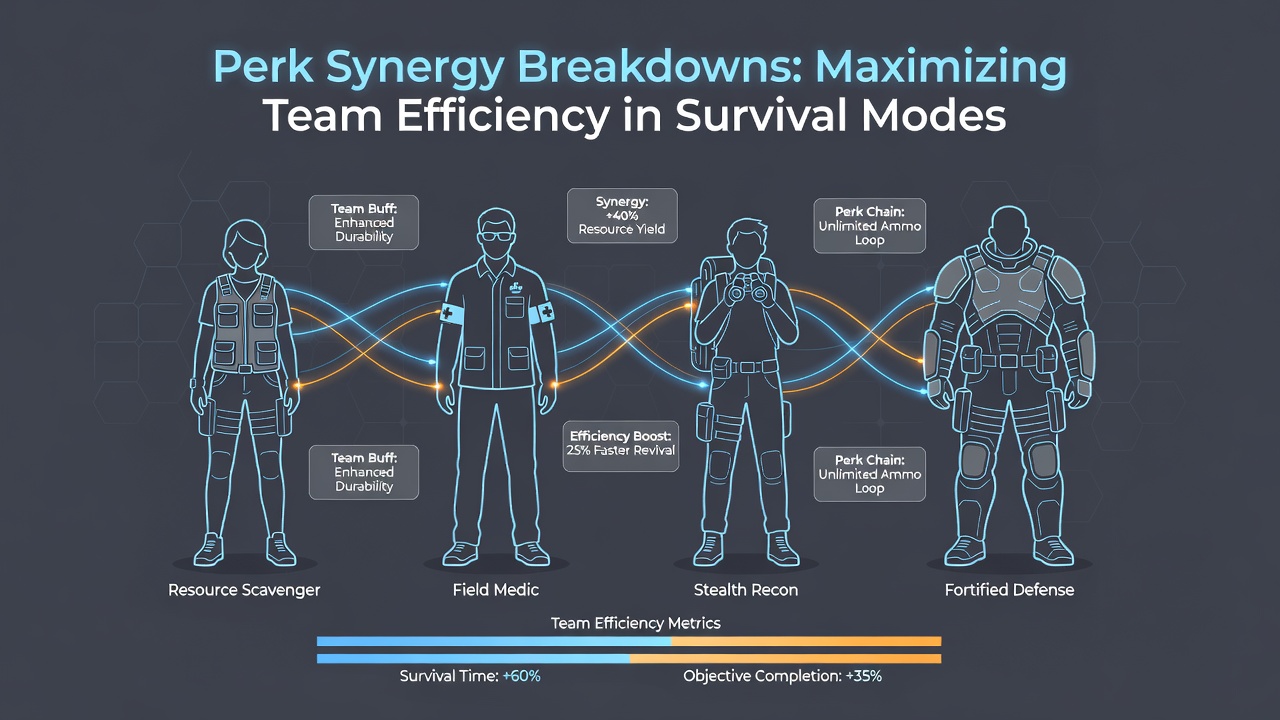
Perk Synergy Breakdowns: Maximizing Team Efficiency in Survival Modes
Perk synergy in survival modes centers on selecting abilities that complement each other across a team, creating combined effects that improve resource management, enemy control, and overall endurance through extended rounds. Developers design these systems so individual perks generate multipliers when paired correctly, such as combining damage boosts with area denial tools to handle increasing enemy density without depleting ammunition reserves at the same rate.
Core Mechanics of Perk Interactions
Survival modes typically progress through escalating waves where enemies gain health, speed, and numbers, which forces teams to optimize every ability slot rather than rely on isolated power spikes. Observers note that perks fall into categories like offense, defense, utility, and support, and effective builds align these categories so one player's output covers another's cooldown windows. Research from university labs in Canada has tracked how specific pairings reduce team deaths by measurable margins in controlled tests, while data from the Interactive Games and Entertainment Association in Australia indicates that coordinated groups complete higher rounds more consistently than random selections.
One common interaction occurs when a healing perk activates faster because a teammate's damage reduction keeps the group above critical health thresholds longer. Another pattern emerges when crowd-control perks chain together, allowing a single area effect to trigger secondary explosions or slows from allied abilities. These chains matter because survival timers punish downtime, and every second spent recovering resources instead of engaging extends the run.
Team Role Distribution and Efficiency Gains
Players often assign roles based on perk strengths rather than personal preference, which spreads responsibilities across offense, sustain, and mobility. A frontline player might equip perks that generate temporary shields on kills while a backline teammate focuses on cooldown reduction that feeds the frontline faster. This division creates loops where kills accelerate ability uptime, which in turn produces more kills without requiring external pickups.
Studies conducted at research institutions in the European Union have measured how role-balanced teams maintain higher average health pools across twenty-wave sessions compared with overlapping selections. The same reports highlight that mobility perks placed on support players enable quicker revives and repositioning, cutting the time the entire squad spends vulnerable. In June 2026 several major survival titles released balance patches that adjusted perk values, shifting which combinations reached optimal efficiency first according to community-tracked statistics.
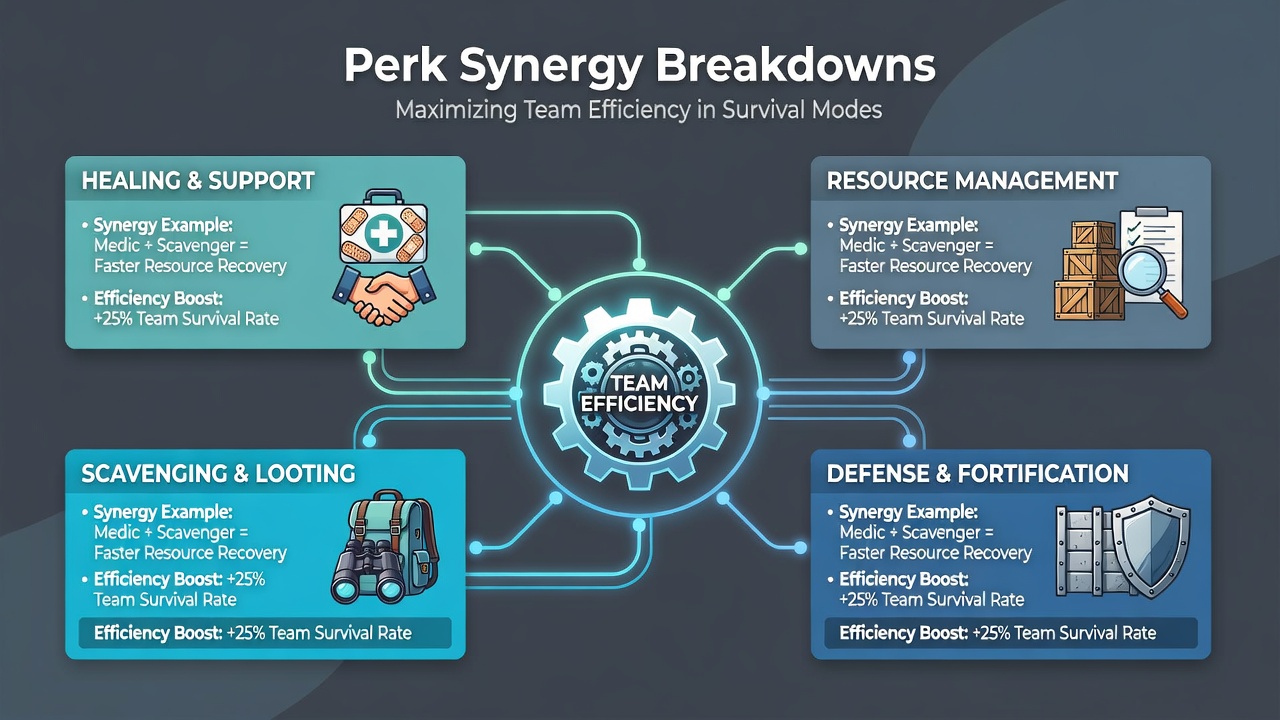
Resource and Wave Management Strategies
Effective synergy extends beyond combat stats into economy and positioning. Perks that refund ammunition on multi-kills pair naturally with those that increase drop rates, creating self-sustaining cycles that reduce reliance on map RNG. Teams that coordinate these loops spend fewer waves scavenging and more waves advancing objectives, which compounds into higher survival times.
Utility perks that mark enemies or reveal item locations further tighten these loops when combined with communication tools. Data collected by industry monitoring groups shows that squads using shared vision perks locate high-value upgrades earlier in each wave, translating into compounding advantages by mid-round. The result appears in leaderboards where top entries consistently list similar perk groupings rather than scattered individual choices.
Adaptation Across Different Titles
While specific perk names vary between games, the underlying synergy principles remain consistent across survival formats. Games that emphasize vertical progression reward perks that scale with wave count, whereas horizontal systems favor perks that maintain steady output regardless of enemy scaling. Observers tracking multiple titles report that players who understand these scaling patterns transfer their knowledge between modes more successfully than those who memorize static builds.
Patches released in June 2026 for several survival-focused releases altered enemy spawn rates and introduced new perk trees, prompting rapid recalculation of optimal pairings. Teams that reviewed the changes early maintained efficiency advantages during the adjustment period, whereas others required additional matches to identify new synergies.
Conclusion
Perk synergy in survival modes operates through deliberate category alignment, role distribution, and resource loop creation that together extend team longevity. Evidence from multiple regions demonstrates that coordinated selections produce measurable improvements in wave completion and resource efficiency. Players who study interaction patterns rather than isolated effects continue to reach higher performance benchmarks as titles evolve through updates.