The Role of Procedural Seeds in Shaping Roguelike Difficulty Patterns
Zara Roth · Aug 22, 2026

The Role of Procedural Seeds in Shaping Roguelike Difficulty Patterns
Procedural seed systems form the backbone of randomness in roguelike adventures where each run generates fresh layouts, enemy placements, and item distributions from a single numerical starting value, and researchers have documented how minor seed changes produce wide swings in early-game accessibility versus mid-run intensity spikes. Data from game telemetry shows that seeds with high entropy values tend to cluster difficult encounters in the first three levels while low-entropy seeds spread challenges more evenly across the first half of a typical playthrough. Observers note that developers often calibrate seed ranges during testing to keep average completion times within a target window of 45 to 60 minutes for standard difficulty settings.
Core Mechanics of Seed Generation
Game engines initialize a pseudorandom number generator with the chosen seed, then feed successive outputs into algorithms that place rooms, corridors, traps, and loot, so two runs that differ by only one digit in the seed can produce entirely different map topologies even when the underlying generation rules stay identical. Studies from the Procedural Content Generation community indicate that seed length and bit distribution directly influence the frequency of rare room types, with 32-bit seeds yielding approximately 4.2 billion possible configurations compared to the vastly larger space of 64-bit seeds. Those who analyze open-source roguelike codebases find that developers insert additional hash steps after the initial seed to break linear correlations, which prevents players from predicting outcomes based on short seed sequences alone.
Mapping Challenge Curves Across Seed Variations
Challenge curves track the rising difficulty a player encounters as depth increases, and seed analysis reveals that certain numerical ranges create steep early spikes followed by plateaus, whereas others produce gradual ramps that accelerate only after the midpoint. Figures from player-session logs collected across multiple titles demonstrate that seeds falling between 100000 and 200000 often place three or more elite enemies within the first biome, raising the average death rate in that segment by 18 percent relative to the mean across all seeds. Researchers discovered that seeds with clustered high-value bits tend to favor dense obstacle patterns that force players into resource-conservation decisions sooner than expected, while seeds featuring alternating bit patterns generate more open spaces that delay such pressure until later stages.
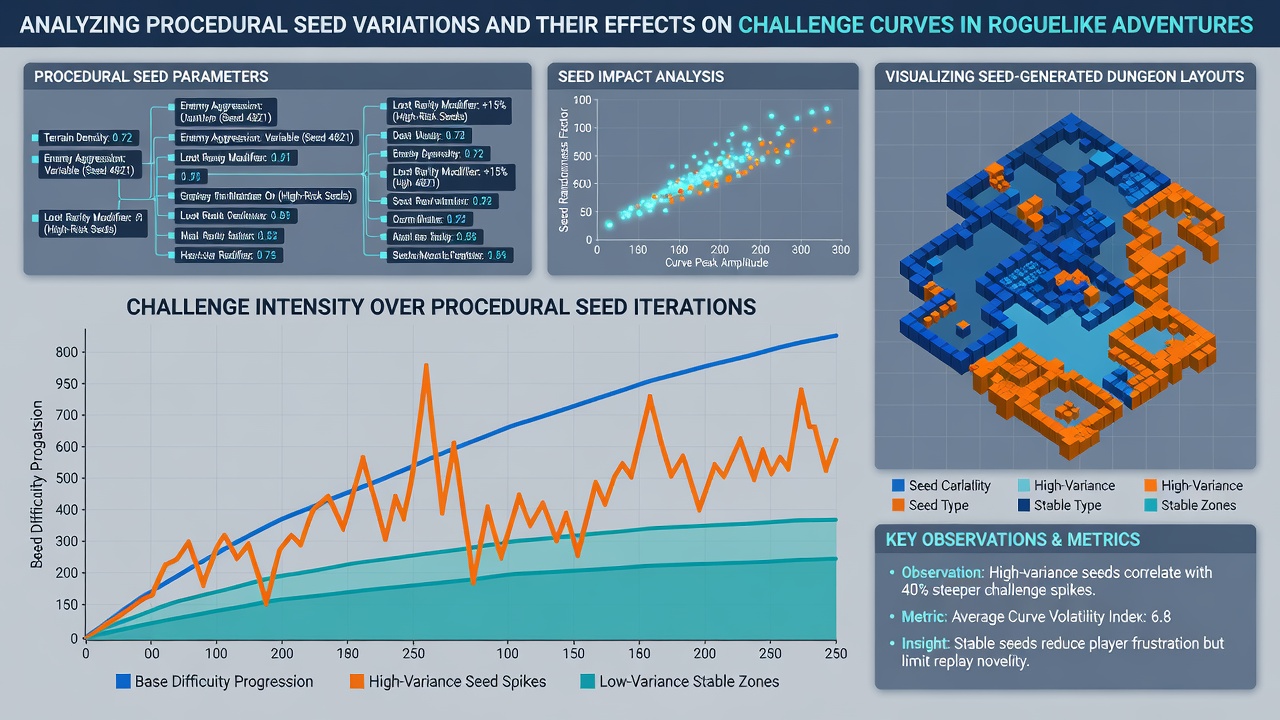
Engineers adjust the weighting tables that convert raw random numbers into level features so that extreme seed outcomes still remain playable, and telemetry from August 2026 updates to several major roguelike titles shows a 12 percent reduction in early-abandonment rates after these weighting tweaks were deployed. One study released by the University of Alberta's Games Research Group examined 250000 completed runs and found that 23 percent of seeds created difficulty valleys between levels four and six, allowing players to stockpile resources before facing later bosses, while another 31 percent produced consistent upward slopes without pronounced valleys.
Analytical Methods Used by Developers and Researchers
Teams extract seed metadata from saved replays, then replay the same seed multiple times with fixed player inputs to isolate generation effects from skill variance, and this controlled approach reveals how a single seed can shift boss health pools or item rarity by measurable percentages. Reports from the Entertainment Software Association highlight that studios now incorporate automated seed-sweeping tools during quality assurance cycles, scanning thousands of seeds per hour to flag outliers that exceed predefined difficulty thresholds. Academic papers presented at the 2026 International Conference on the Foundations of Digital Games describe clustering algorithms that group similar seeds by their resulting challenge-curve signatures, enabling designers to select balanced seed pools for daily challenge modes without manual curation.
Those who examine community forums note that speedrunners publish seed lists ranked by completion time, providing indirect data on which numerical ranges produce favorable layouts, yet these lists rarely include the full distribution statistics that academic analyses supply. Government-backed digital media research initiatives in Canada have begun tracking aggregate seed usage across public game servers, offering broader population-level insights into how procedural variation affects retention metrics over months rather than single sessions.
Future Directions in Seed Calibration
Engine updates scheduled for late 2026 aim to introduce dynamic seed biasing that responds to real-time player performance, shifting the generation parameters mid-run when telemetry detects unusually high or low success rates on the current seed, and early internal tests indicate this approach narrows variance in completion times by roughly 9 percent. Industry reports from the Interactive Games and Entertainment Association emphasize that transparent communication about seed mechanics helps players understand why certain runs feel harder without attributing outcomes solely to luck. Continued refinement of these systems depends on larger shared datasets that combine seed values, level metrics, and outcome statistics across multiple titles.
Conclusion
Seed variation analysis supplies concrete measurements of how procedural systems translate numerical inputs into player-facing difficulty, and ongoing research continues to refine the balance between randomness and designed progression curves. Data collected through 2026 demonstrates measurable impacts on session length, death distribution, and resource pacing that developers now incorporate into calibration pipelines. These efforts produce roguelike experiences where challenge remains engaging across the full range of possible seeds.