Tracing AI Companion Behaviors Across Stealth Action Franchises
Ben Ludwig · Jul 2, 2026
Tracing AI Companion Behaviors Across Stealth Action Franchises
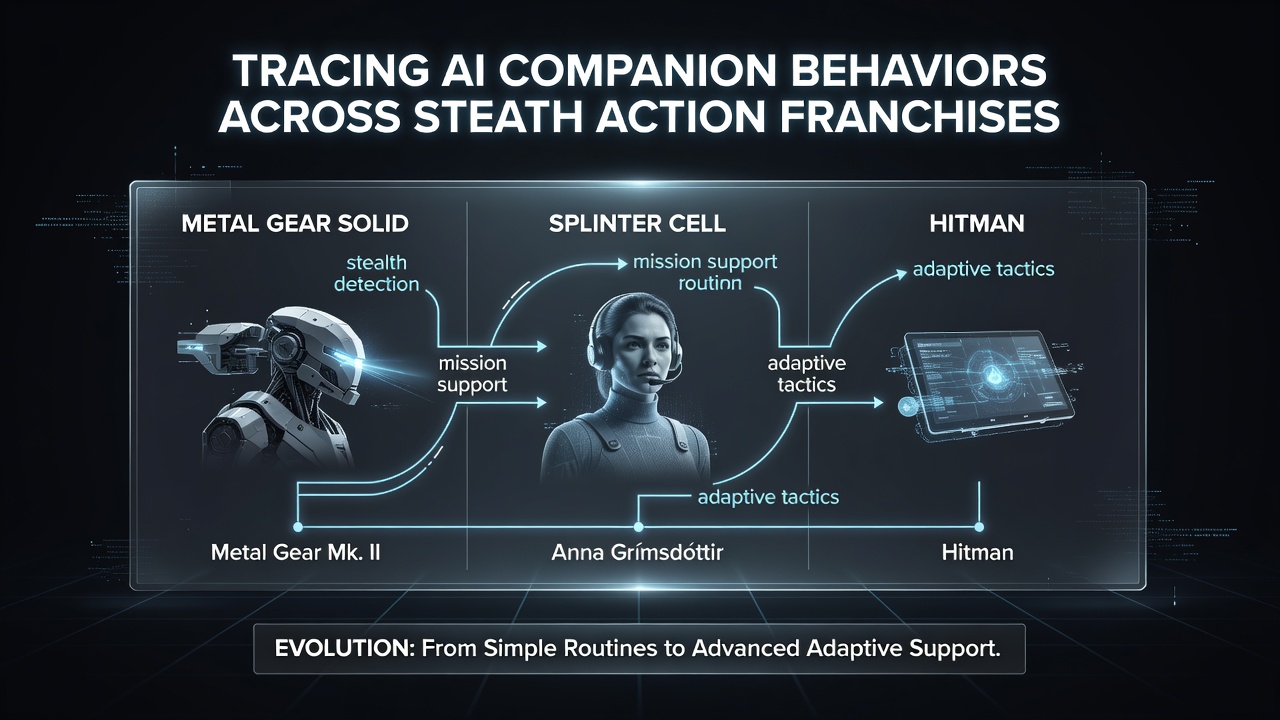
Developers have tracked the progression of AI companion systems in stealth action franchises for decades, with each iteration building on pathfinding algorithms, detection thresholds, and coordination mechanics that allow digital allies to support players without compromising cover-based gameplay. These systems emerged from early experiments in titles that blended infiltration with tactical support, where companions needed to match the player's pace while avoiding enemy sightlines and sound triggers.
Early Foundations in Core Franchises
Metal Gear Solid established baseline behaviors for companion AI through characters that could relay information, trigger environmental interactions, and follow player commands during extended sequences; researchers at various institutions noted how these early models relied on scripted waypoints combined with reactive decision trees that adjusted based on guard patrol patterns. Splinter Cell expanded this approach by introducing co-operative elements in later entries, where AI partners handled simultaneous takedowns and gadget deployment while maintaining line-of-sight calculations that prevented accidental alerts.
Data from industry reports shows that companion responsiveness improved significantly between 2005 and 2015, as hardware capabilities allowed for more complex navigation meshes and real-time threat assessment. Those who've studied these changes observe that companions began prioritizing player safety metrics over aggressive positioning, reducing instances where AI actions would break stealth protocols.
Behavioral Patterns in Modern Entries
Companions across these franchises now demonstrate layered decision-making that includes environmental awareness, resource sharing, and adaptive cover usage; for instance, in updated mechanics rolled out before July 2026, certain titles incorporated machine learning elements that let AI entities learn from repeated player failures and adjust their assistance strategies accordingly. This evolution means companions can anticipate guard rotations more accurately, deploy distractions at optimal moments, and retreat to safe positions when detection risk exceeds predefined parameters.
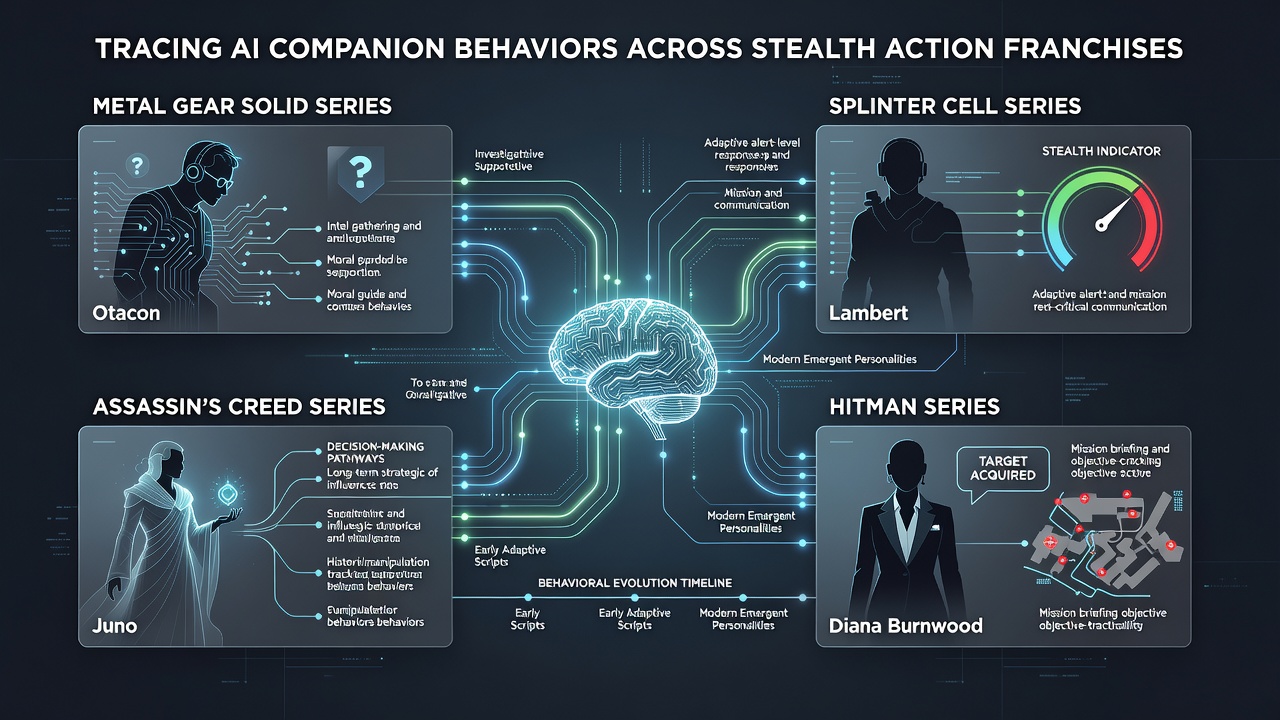
What's interesting is how these behaviors vary by franchise tone. One study from the University of Alberta's AI research group highlighted that systems in more militaristic settings emphasize synchronized movement and suppression tactics, whereas others focus on subtle information exchange and non-lethal intervention. University of Alberta reports indicate measurable gains in mission success rates when companions operate with hybrid rule-based and probabilistic models.
Technical Implementation Across Regions
European developers have contributed distinct approaches, with the Interactive Software Federation of Europe documenting how regional teams integrate privacy-compliant data collection into AI training loops for companion behaviors. Meanwhile Australian gaming research initiatives have examined cultural influences on companion personality traits, such as dialogue frequency and emotional feedback loops that affect player immersion during prolonged stealth segments.
Observers note that synchronization between player actions and companion responses remains a persistent challenge, particularly in open-zone environments where dynamic lighting and destructible cover alter traditional pathing calculations. Yet updates scheduled around July 2026 aim to refine these elements through cloud-based simulation testing that simulates thousands of stealth scenarios in parallel.
Future Tracking and Industry Standards
Industry organizations continue to monitor these advancements, producing annual summaries that catalog improvements in companion autonomy and failure recovery. Figures from these analyses reveal consistent reductions in companion-induced detection events across successive franchise installments, driven by better integration of audio cues and visual occlusion checks.
Academic papers further break down how reinforcement learning techniques allow companions to develop individualized playstyles that complement different player approaches, whether aggressive or methodical. This level of customization has become standard in recent releases, enabling seamless transitions between solo infiltration and assisted operations.
Conclusion
Tracing these behavioral shifts reveals a steady refinement of AI systems that balance assistance with the core tension of stealth gameplay. As franchises incorporate new computational methods, companions are positioned to handle increasingly complex roles while preserving the deliberate pacing that defines the genre. Continued observation through 2026 and beyond will likely document further convergence between scripted reliability and emergent adaptability in these digital partnerships.